Alternative Title: Amateur Hour!
There is a tendency among record people to obsess over the shittier version of something good. Of course you love the Beatles, but do you know there’s a 60s group of Surrey teenagers who contributed one track to a compilation of local rock bands that is recorded in a shed? Steely Dan is great but have you heard of that Swiss Library record that contains a 1:30m version of a pretty promising Disco-Jazz track? Sure, we all love Egyptian Lover, but have you heard of this Milwaukee Hip Hop crew fronted by a Scientologist that dropped one obscure 7” in 1985 about how crack is bad that now costs 1.800$?
I’m half jestin’, but if I am honest, I am very much guilty of this. There are local Christian Funk bangers from tiny German labels that I like better than some objectively superior US classics. And I handily prefer the Rap-O-Clap-O version by Cora & die Popspatzen over the one by Joe Bataan.
If you’re a fan of a certain type of music there is simple pleasure in witnessing people imitating it and, while fucking up, developing a whole new type of sound. Call it outsider art or schadenfreude but certain ways of failing make your music special.
Who cares about the rares?
However: When it comes to fast-paced electronic music from the 1990s, this love for local amateurisms doesn’t seem to exist in the same way as it does in other genres.
Sure: certain subgenres, especially tech-house and minimal, have embraced their regional weirdos, often hyping up rare oddball labels and quirky DIY-releases. You could argue that many of these EPs going through the digger-hype-cycle are simply serviceable takes on established genres that are somewhat interchangeable and rarely add much unique flavor. And that their desirability is rather derived from their rarity than their musical appeal. But at least people care.
In the communities surrounding happy hardcore, rave music and jungle, people seem to care less, especially about music from beyond Great Britain. To me it seems that, the closer a track is to the original UK rave communities between 1990 bleeps and 1996 roller, the more likely that it’s gonna enter a kind of canon making it desirable to own and play. And everything that strays too far from that path is a failure that people don’t really care about outside of highly specific circles.
As someone based in Germany who loves digging for rave music, this has put me in a predicament: I love the artists and labels that originated these sounds, but it’s pretty rare to stumble over a stack of Impact or Homegrown 12”s in the €-bin of a dusty Berlin antiques shop (though it does happen), because breakbeat hardcore and happy hardcore were simply not massively popular genres in Germany – at least compared to stuff like techno, acid, house and hard trance. And even within the niche genre of hardcore a lot of German stuff is much more adjacent to Frankfurt acid escapades and in full honesty a little stressful for me.
Sure, if you know where to look there are loads of terrible major label euro trance records that house a pastiche “happy rave” remix with an amen break on the b-side to cash in on that particular craze between 1994 and 1996, and occasionally these are even sort of good! Sometimes there might even be a dilettante attempt at Jungle which I especially love – see this one for example by Jam & Spoon who are now much more remembered for their contributions to trance than their jungle experiments.
So: the major labels were content with ticking some ravey boxes to market what I would endearingly call cheesy Euro-slop. Is that all there is in continental Europe?
Any German jungle in guy?
No! There were some magnificent pockets of nerds in the DACH region (Germany, Austria & Switzerland) that were inspired by the UK’s buzzing scenes, and that had the talent to not only imitate these genres but to add to them and as outsiders become part of hardcore history (not the podcast).
There are several examples for these types of artists that have earned the respect of their British peers, some of which I hope to cover on this page. I would have to mention the likes of Martin Damm (aka. Biochip C. or Speed Freak), Ilsa Gold, Atari Teenage Riot, and many more but in my view the real heroes are the subjects of today’s text, Space Cube.
Space Cube is a project by Ian Pinnekamp, later known as Ian Pooley, and Thomas Gerlach, later known as DJ Tonka. Both of them are now known as German house royalty with Pooley having done remixes for Daft Punk and Tonka calling himself “𝙶𝚎𝚛𝚖𝚊𝚗𝚢’𝚜 𝚏𝚒𝚛𝚜𝚝 𝚑𝚘𝚞𝚜𝚎, 𝟸-𝚜𝚝𝚎𝚙, 𝚓𝚞𝚗𝚐𝚕𝚎 𝚊𝚗𝚍 𝚍𝚛𝚞𝚖 & 𝚋𝚊𝚜𝚜 𝚙𝚛𝚘𝚍𝚞𝚌𝚎𝚛” in his IG bio. But before they became house-hold names haha with interviews on VIVA and chart listings, they had several joint music projects in their late teens and early 20s (between 1991 and 1996-ish), the most prolific of which was called Space Cube.
I remember hearing them first when Young Lychee bought this one at AudioIn before Covid straight from the turntable of the person sorting through a new stack (this was before they established their protocol for new records) for 30€, which was an unbelievable amount to me at the time, but I still envy him for it. I truly fell in love with Space Cube later when I heard the classic track “Session” in this mix by Mathis Ruffing and Souci, you can still see my stunned 5 years old SoundCloud comment.
Crashin’ for a “Session”
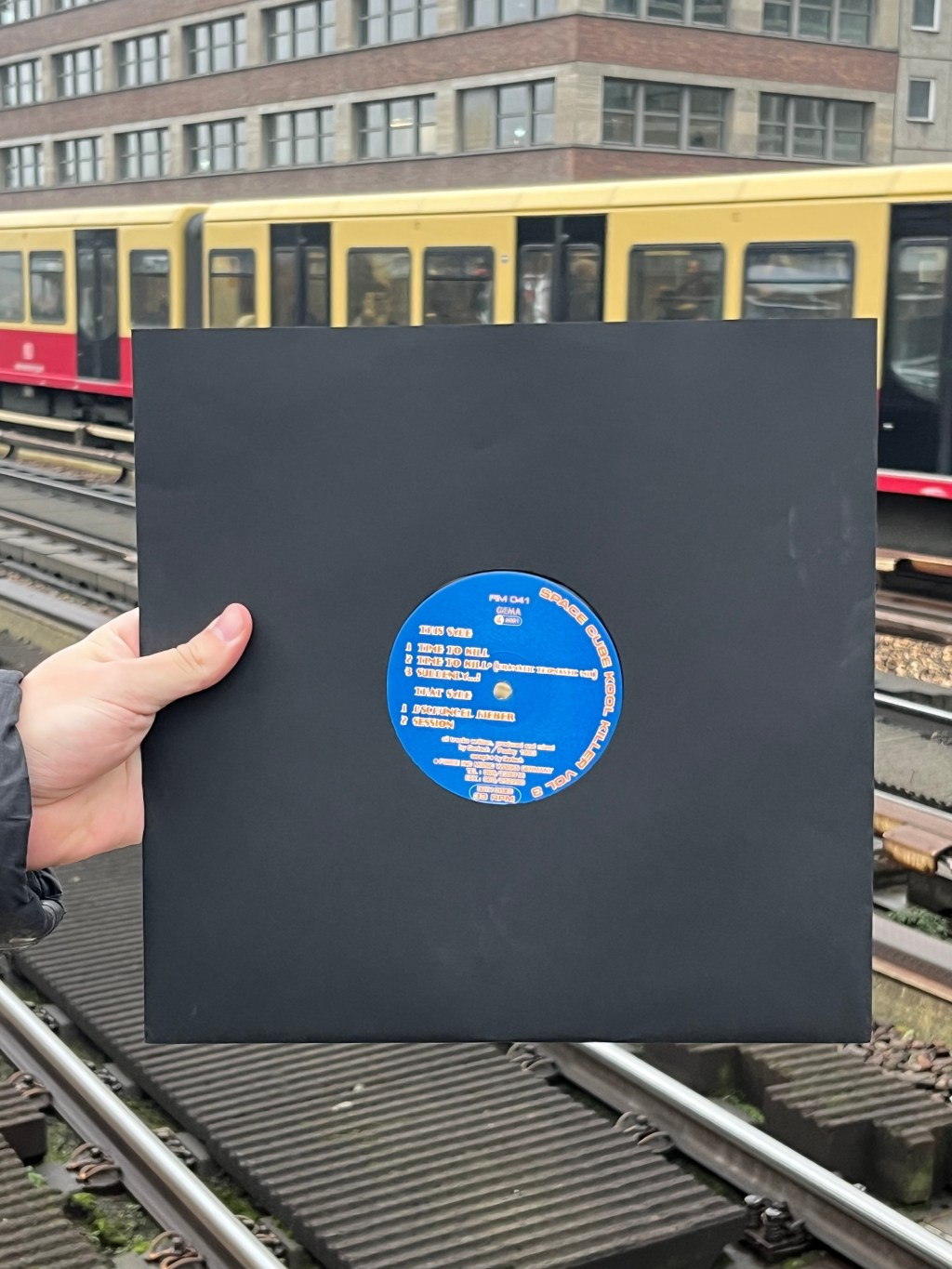
“Session” is the cult classic off of Space Cube’s “Kool Killer Vol 3”, which is the subject of today’s text in case you didn’t notice, and that’s truly justified. It’s so god damn fun and raw and DJ-able, and still gets a crowd going today with its Flavor Flav sample – sidenote: it’s funny how prominent Chuck D is sampled pretty much everywhere while I can hardly think of Flavor Flav samples in dance music – and its perfectly sorta-cheesy-but-not-too-cheesy Pet-Shop-Boys-sampling breakdown. See young Young Lychee and young myself having a ton of fun mixing it over here. As a Discogs-rando put it in 2006: “This is certainly one of German hardcore’s finest moments.”
While “Session” is the objective standout of the EP, it has one problem: It’s so perfect that you’d never think it was made by a duo of 20 (!) year olds from Germany’s Main area. It fits so well between a Vibes & Wishdokta B-side or a DJ Sy banger that you’d never in a million years think that this wasn’t made by someone from Cornwall or Leeds or whatever.
That’s why I am also particularly fond of another track from Kool Killer 3, “Dschungelfieber”. It’s not that this track is any less professional, but with its use of German vocals it scratches that exact itch of wanting to find the German version of something cool, while still being incredibly competent.
Cards on the table, though: I have to say I usually forgo the dark and acid-laden original version on Kool Killer 3 in favor of the duo’s own reimagining of the track on their remix EP on the legendary Riot Beats label. A guaranteed floor filler that will put a smile on people’s face not only through its Dschunglist vocals (If you know where they are from please write a message), but also through one of the most fiercely chopped breaks I’ve heard on a German release.
Another highlight is “Time To Kill” with its iconic sample of Peter Schilling’s stellar 1982 NDW hit “Major Tom”. This one abandons Session’s boiled down ecstatic energy level in favor of a more cut-and-paste breakbeat rave approach that almost leans into slapstick. Through its more chaotic vibe this one feels a little more dated and its synth programming is more in line with some of the stressful German hardcore from that era. But as anyone who loves UK hardcore will be able to tell you: hectic mash-ups of absurd samples that shouldn’t work together but somehow do is also a staple of early British rave music that Pooley and Tonka nail perfectly.
If this is something you’re interested in, I’d also recommend tracking down the other “Kool Killer” releases by Space Cube since they are a bit more on the mash-up ironic side of things with their unexpected samples and sudden switch-ups.
“Suddenly”, finally, is a great track, too, which has the unfortunate fate of having been put on a record with some of “German hardcore’s finest moments”. It’s very catchy and serviceable but I simply always forget it exists. Writing this text has made me keen to close a set with it, though, since it really is a perfect track for when the lights have turned on in the club and the people yearn for one final campy hug before heading to the train station.
I could go on about Space Cube, about their other releases and about their home label Force Inc. (objectively the most forward thinking rave music label in Germany between 1992 and 1996-ish) forever, and I’m sure I will in future articles. And I’d also love to find out more about their relationship to that project given that they made all this amazing music when they were SO young, and their later polished music could hardly be more different from Space Cube’s raw, demanding, sometimes ironic, and not always DJ friendly edge.
For now I’ll just say: Do yourself a favor and hunt down an affordable copy, because there are few joys in life like teasing the beginning of “Session” a couple of times and then finally mixing it in. “JA BITTE”.
 this DJ Blogs Himself
Leave a comment